From Arriving Too Late to Be an Actual Witness to Being a Suspect: How Racial Bias Shaped the Capital Murder Case Against Eddy Grant
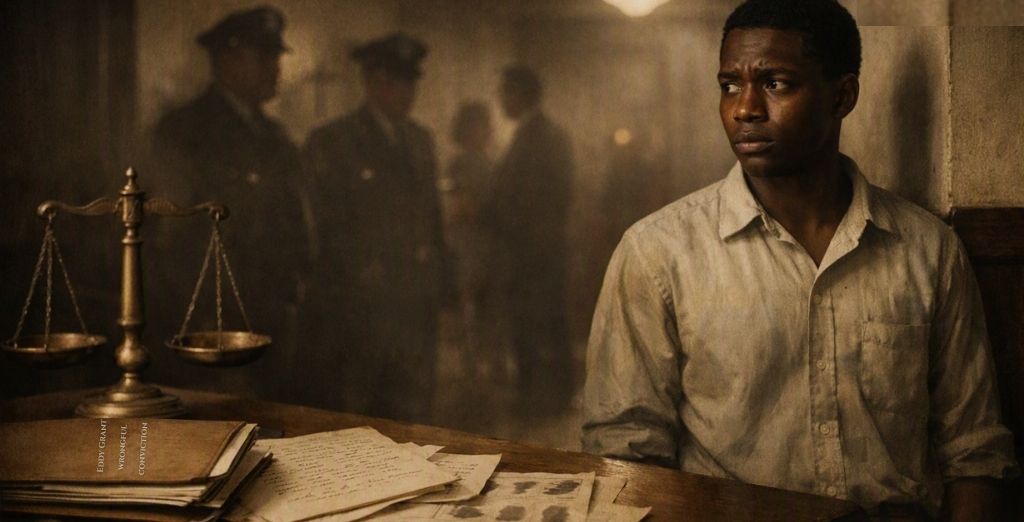
Eddy Grant, as a young Black man in 1956 Mississippi, entered Black vs White by Susan Ogden Benting & Takezo Art too late to witness a terrible crime. Nineteen-year-old Eddy found his girlfriend, Lucille Washington, after her murder. He barely had time to understand what he had seen before someone struck him, and he lost consciousness. When he woke up, the scene was staged to accuse him of Lucille’s murder.
A bloody weapon lay nearby. Lucille was dead. Eddy was surrounded by officials who found his guilt easier to accept than his innocence. This rapid shift of Eddy’s status from witness to suspect shows how racial bias influenced criminal investigations every step before a trial began.
The Crime Scene Became a Ready-Made Story
The evidence near Eddy gave the police a simple account. He was present; the weapon was close, and he could not explain everything that had happened. Those details created suspicion, but they did not establish guilt.
A careful investigation would have tested several queries. Why was Eddy unconscious? Were other people present? Who attacked him? Who handled the weapon? Did the physical evidence support the theory the police held?
The investigation moved in another direction. Officers treated Eddy’s presence as the answer. Facts that might have challenged their conclusion received little attention. The case began to close around a young man who entered the scene after the crime.
Racial Bias Shaped Who Received the Benefit of the Doubt
Eddy’s race affected how people interpreted his actions. Fear appeared suspicious. His confusion sounded dishonest. His inability to give officials the answers they expected became another reason to distrust him.
The same suspicion did not fall equally on people with status and connections. Governor James White and his family had political power, reputation, and public respect. Eddy had none of those advantages. His account had to compete against assumptions that existed before police asked their first question.
The novel Black vs White presents racial discrimination through these differences in credibility. Eddy received scrutiny because of the color of his skin. Others remained beyond suspicion because of the names, political, and family connections they carried.
A Coerced Confession Replaced Unanswered Questions
Police pressured Eddy into signing a confession. Once his name appeared beneath a statement of guilt, officials treated the document as confirmation that Eddy had committed the crime.
The confession gave the prosecution a direct story for court. It also distracted the court’s attention from the conditions under which police obtained the confession. Eddy was frightened, injured, isolated, and dependent on authorities who had already decided he committed the murder.
His signature could not explain the physical evidence or identify the person who struck him. Yet the confession became more persuasive than the unanswered questions because it fit the biased conclusion already in place.
The Courtroom Inherited the Investigation’s Bias
Eddy entered court with a serious disadvantage. Police had labelled him guilty; the prosecution had his signed confession, and public opinion had little reason to question either.
His legal defense failed to challenge crucial gaps. The trial moved quickly, and the jury took only 19 minutes to reach a guilty verdict. Eddy received a death sentence.
The jurors were deciding whether a 19-year-old should live or die, yet they spent less than half an hour considering the evidence. Their speedy decision suggested that the confession and assumptions surrounding Eddy had already done the work. The trial gave a legal ending to a conclusion formed much earlier.
Samuel Jackson and Richard Black Return to the Evidence
Retired attorney Samuel Jackson and former FBI agent Richard Black later review the case. Their investigation begins with questions that should have been asked from the start.
They examine the rope, fingerprints, the cigar, the knife, and other physical details connected to the crime. The evidence points to facts beyond the story used to convict Eddy. Their work reveals the cost of police tunnel vision. Once the original investigators were committed to one suspect, they ignored leads that allowed the truth to disappear.
Samuel understands the racial conditions surrounding Eddy’s conviction. Richard brings investigative experience. Together, they test the case through evidence rather than reputation, pressure, or convenience.
What Eddy Grant’s Case Adds to the Story of Racial Injustice
Black vs White shows racial injustice as a series of decisions. Police decided whom to suspect. Investigators decided which evidence mattered. Lawyers decided which questions to raise. Jurors decided how much time a life deserves. Powerful officials decided which truths threaten them.
Eddy’s wrongful conviction grew from those choices. Each failure strengthened the next until a false accusation became a death sentence. Readers interested in similar stories can explore our list of 5 Recent Books About Racial Injustice and Unfair Trials to Read in 2026. The books approach the subject through memoir, investigative reporting, true crime, and historical fiction. Eddy’s story gives the list a focused fictional example of how racial bias, coerced confession, weak defense, and ignored evidence can combine inside one case.